If you’re spending time celebrating your Instagram follower count or cheering every time a post gets a hundred likes, I have some news for you: none of that is moving your business forward. Vanity metrics feel good. They look impressive in screenshots. But they have almost no connection to the thing that actually matters — revenue. As an SEO agency that has worked with small and mid-sized businesses since 2007, we’ve watched business owners get completely distracted by numbers that don’t pay the bills. This post breaks down which metrics are costing you time and attention, which ones actually drive SEO performance and sales, and how to start making data-driven decisions that impact your bottom line.
What Are Vanity Metrics, and Why Are They a Problem for Your SEO?
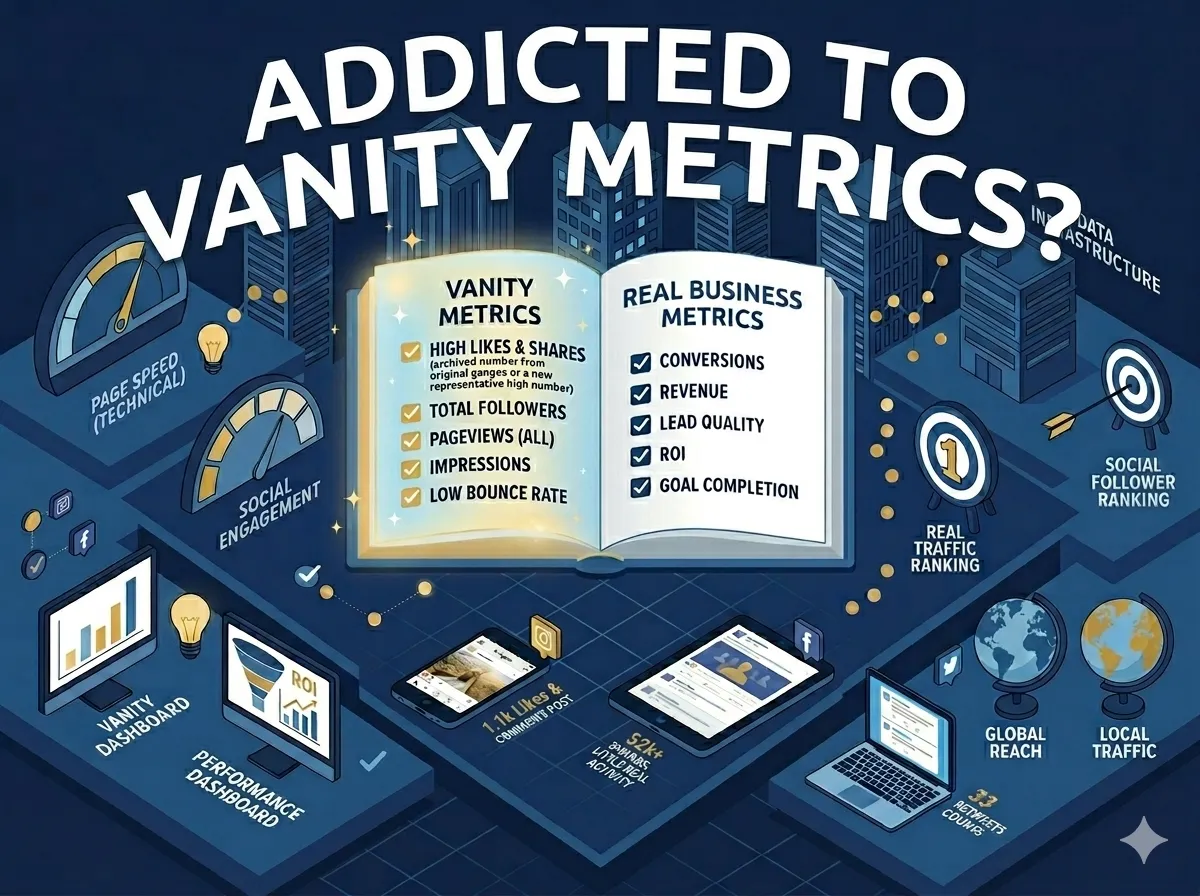
Vanity metrics are numbers that look impressive but don’t correlate with business outcomes. Social media followers, post likes, total page views, and raw subscriber counts all fall into this category. They’re easy to track, easy to share, and — here’s the problem — completely disconnected from whether your SEO is working or whether anyone is actually becoming a customer.
The issue isn’t just that vanity metrics are misleading. It’s that focusing on them pulls your attention away from the metrics that actually tell you something useful. Every hour you spend analyzing likes is an hour you’re not spending on understanding what your SEO is actually delivering.
Why Don’t Social Metrics Help Your Search Rankings?
Social signals — likes, shares, follower counts — are not a confirmed Google ranking factor. While social media can support your SEO indirectly by amplifying content and generating backlinks, the raw engagement numbers on your posts have no direct impact on where you rank in search results. Building a strategy around follower growth while neglecting your website’s technical health and content quality is working on the wrong problem entirely.
What Does the Vanity Metrics Trap Look Like in Practice?
A business owner posts consistently on LinkedIn, watches their follower count climb, and feels like things are going well. Meanwhile, their website traffic is flat, their conversion rate hasn’t moved in six months, and they have no idea which pages are actually driving inquiries. That’s the vanity metrics trap: the appearance of progress without any of the substance.
The fix isn’t complicated, but it does require shifting what you measure. Instead of tracking how many people saw your post, track how many people landed on your site from search, what they did when they got there, and whether they converted into a lead or sale.
Which Metrics Actually Tell You If Your SEO Is Working?
Actionable metrics are numbers that connect directly to a business outcome. They tell you something specific you can act on. Here’s where to focus your attention:
- Organic search traffic: How many visitors are arriving through unpaid search results? This is the most direct measure of whether your SEO is producing visibility.
- Conversion rate: Of all the people who visit your site, what percentage take a meaningful action — a contact form submission, a phone call, a purchase? This is your most important business metric.
- Keyword rankings: Are you ranking for the terms your ideal clients are actually searching? Tracking rank movement tells you whether your content strategy is working.
- Bounce rate and time on page: If visitors are leaving immediately, your content isn’t matching their intent. Understanding search intent is critical to keeping people on your site.
- Customer lifetime value (CLV): Which traffic sources are bringing in customers who stay, spend more, and refer others? CLV connects your marketing effort to long-term revenue.
How Should I Use Google Analytics to Track the Right Data?
Google Analytics 4 gives you everything you need to move beyond vanity metrics — but it requires a little setup to get the most out of it. Start by configuring conversion events: phone call clicks, form submissions, or whatever action signals a real lead for your business. Once those are in place, you can see not just how much traffic you’re getting, but which pages and sources are actually producing results.
If GA4 feels overwhelming, a good starting point is your SEO audit. A thorough audit will identify which pages are driving traffic, which are underperforming, and where the biggest opportunities are for improvement.
What Role Do Calls-to-Action Play in Turning Traffic Into Revenue?
Traffic without a clear next step is wasted. A strong call-to-action on your homepage and key service pages gives visitors a reason to engage — and gives you a way to measure that engagement. Whether it’s a free consultation, a downloadable guide, or a direct phone number, your CTA turns anonymous visitors into trackable leads. If you don’t have a clear call-to-action on your website, that’s the first thing to fix before worrying about any other metric.
How Do You Build a Dashboard Around Actionable Metrics?
You don’t need to track everything — you need to track the right things consistently. A simple dashboard built around four or five actionable metrics will serve you better than a sprawling analytics setup you never look at.
Start with these as your core KPIs:
- Monthly organic traffic (are more people finding you through search?)
- Lead conversion rate (are those visitors becoming inquiries?)
- Top-performing pages by organic traffic (what content is working?)
- Position tracking for your target keywords (are you moving up?)
- GEO visibility (is your business appearing in AI tools like ChatGPT, Claude, and Perplexity when people ask about your services?)
That last one deserves attention. AI-powered search tools are increasingly answering questions directly, and if your business isn’t being cited in those answers, you’re missing a growing slice of your potential audience. We track this for our own clients using tools specifically built for AI visibility monitoring — and it’s become a meaningful part of how we measure SEO success in 2025 and beyond.
How Do I Know If My SEO Strategy Is Actually Working?
The clearest sign your SEO is working is that qualified leads are finding you through search and taking action. Not just that your rankings improved, and definitely not that your follower count went up. The question to ask every month is simple: did more of the right people find us, and did more of them reach out? If the answer is yes, your strategy is working. If not, it’s time to ask harder questions about your approach.
Vanity metrics will always be easier to celebrate. But sustainable business growth comes from understanding the numbers that actually matter — and building your marketing decisions around them. If you’re ready to stop guessing and start measuring what moves the needle, we’d be glad to help. Call us at (800) 419-3730 or reach out here — we answer our own phone.
Frequently Asked Questions About Vanity Metrics and SEO
Do social media followers affect my Google search rankings?
Social media followers are not a direct Google ranking factor. While a strong social presence can support your SEO by amplifying content and earning backlinks, the follower count itself has no confirmed impact on where you appear in search results.
What is the most important metric for measuring SEO success?
Conversion rate is arguably the most important metric because it connects your traffic directly to business outcomes. Organic traffic volume matters, but traffic that doesn’t convert into leads or sales isn’t delivering real value.
How often should I check my website analytics?
A monthly review of your core KPIs is typically sufficient for most small businesses. Weekly check-ins can be useful if you’ve recently launched new content or made significant site changes and want to track the impact quickly.
What’s the difference between a vanity metric and an actionable metric?
A vanity metric looks good but doesn’t connect to a decision you can make. An actionable metric tells you something specific that you can act on. Knowing you have 10,000 Instagram followers is vanity; knowing your contact form conversion rate dropped 15% this month is actionable.
What is GEO and why does it matter for my business?
GEO stands for Generative Engine Optimization — the practice of optimizing your content to appear in AI-powered tools like ChatGPT, Perplexity, and Claude when people ask questions related to your business. As more users turn to AI for recommendations, GEO visibility is becoming a meaningful part of a complete SEO strategy.
How do I set up conversion tracking in Google Analytics?
In Google Analytics 4, you can configure conversion events by marking specific actions — such as form submissions or phone call clicks — as key events in the admin settings. If this feels technically complex, an SEO consultant can set it up as part of a broader audit and strategy engagement.