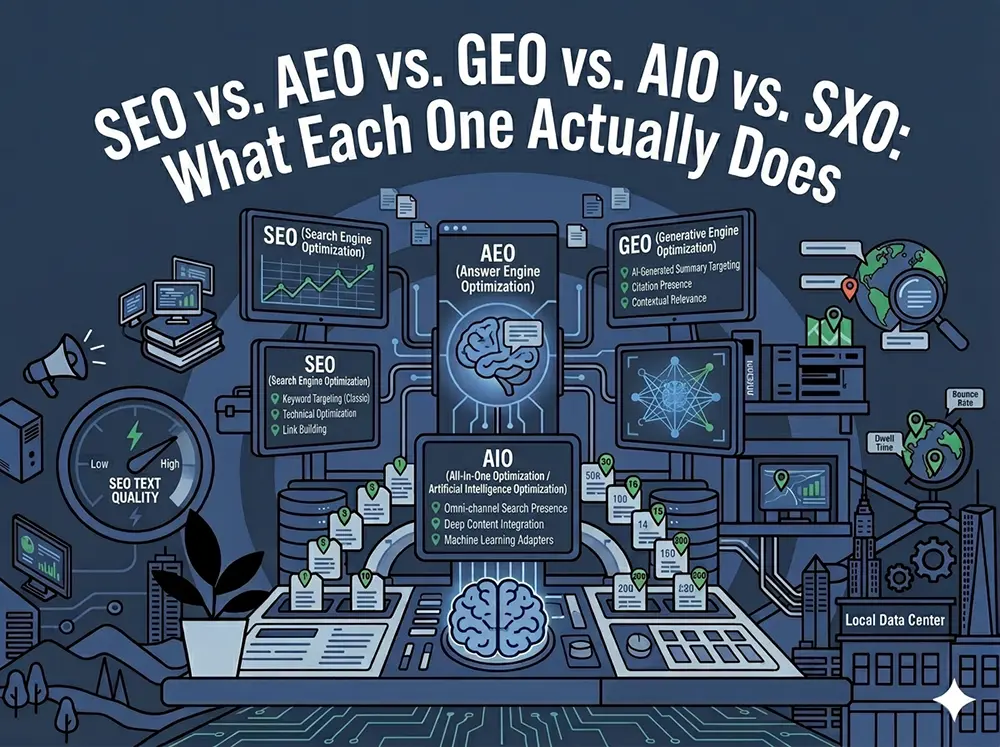
Search doesn’t work the way it did even two years ago. Google still matters, but ChatGPT, Perplexity, Gemini, and AI Overviews are now also deciding which businesses get found, cited, and recommended. That shift has split “SEO” into five related but distinct disciplines: traditional SEO, AEO, GEO, AIO, and SXO.
None of these replace each other. They stack. A page that ranks but doesn’t answer the question won’t get cited by an AI engine. A page an AI engine cites but that loads slowly and doesn’t convert isn’t doing your business much good either. Here’s how we think about each layer, what we handle directly for clients, and what you can start doing on your own today.
SEO: The Foundation Everything Else Sits On
Traditional search engine optimization is still the base layer. If this isn’t solid, nothing built on top of it holds.
High-Intent Keyword Clusters
Grouping related search terms around what your customers actually want to buy, not just what gets the most search volume.
On-Page and Technical SEO
Title tags, headers, page structure, and the behind-the-scenes code that lets search engines read your site correctly.
Backlinks and Domain Authority
Earning links from other credible sites, which still signals trust to Google and to the AI models trained on the web.
Site Speed and Crawlability
A fast, well-structured site that search engines can index without running into dead ends or broken paths.
Quarterly Content Refreshes
Updating older pages with current information instead of letting them go stale and slide down the rankings.
What we handle: keyword strategy, on-page and technical audits, and internal linking structure. What you can do yourself: keep your homepage copy current and make sure anchor text in your own content is descriptive rather than generic.
AEO: Getting Chosen as the Answer
Answer Engine Optimization is about structuring content so it gets pulled directly into featured snippets, voice responses, and AI-generated answers, not just ranked as a link.
Concise, Direct Answers (40 to 60 Words)
Leading with a short, complete answer before expanding into detail, so it can be lifted cleanly by an answer engine.
FAQ and How-To Schema
Structured data that tells search engines exactly which text on your page is a question and which is the answer.
Covering “People Also Ask” Questions
Writing directly to the follow-up questions real searchers ask, not just the primary keyword.
Featured Snippet Targeting
Formatting answers, lists, and definitions in a way that’s easy for Google to extract into the snippet box.
Voice and Mobile Query Formatting
Writing in the natural, conversational phrasing people actually speak into a phone or smart assistant.
What we handle: building out FAQ sections and the schema behind them. What you can do yourself: keep a running list of the questions your customers actually ask you, whether that’s in Google’s autocomplete and People Also Ask boxes or straight from the phone. Those are the exact questions your content should answer first.
GEO: Getting Cited by AI
Generative Engine Optimization is newer and less predictable than SEO. It’s the practice of making your content something ChatGPT, Perplexity, and Gemini can retrieve, trust, and cite when someone asks a question in your category.
Getting Cited in ChatGPT, Perplexity, and Gemini
Appearing as a named source when an AI tool answers a question related to your business or industry.
Factual, Entity-Rich Content
Writing that clearly names your business, location, and services rather than relying on vague or clever phrasing.
E-E-A-T Authority Signals
Demonstrating real experience, expertise, authoritativeness, and trust, the same signals Google has emphasized for years, now doing double duty for AI systems.
Mentions in Forums and Datasets
Showing up in places like Reddit, industry forums, and other sources AI models pull from when they’re built and retrained.
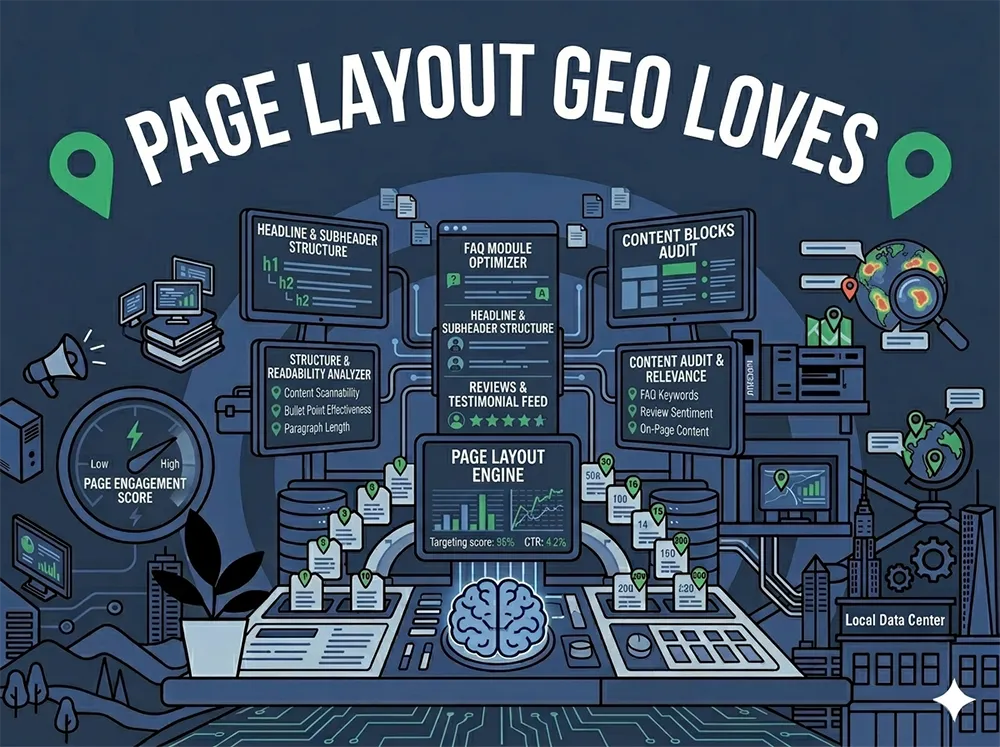
Tables, Headings, and Clear FAQs
Formatting that’s easy for both people and AI systems to scan, chunk, and summarize accurately.
What we handle: GEO strategy and citation tracking, including structuring content so AI systems can pull it cleanly. What you can do yourself: keep your business name, address, and description consistent everywhere you’re listed online. AI models get confused by conflicting information just like search engines do.
AIO: Building a Presence AI Already Trusts
AI Optimization is the long game. It’s less about a single page ranking and more about whether AI systems already know who you are before someone even asks.
Presence in AI Training Data
Having enough of a footprint across the web that your business shows up in the data models are trained on.
Wikipedia, Wikidata, and GitHub Footprint
Structured, verifiable entries on the reference sources AI systems weight heavily for factual grounding.
Consistent Brand Messaging Everywhere
Describing your business the same way across your site, directories, and social profiles so AI doesn’t have to guess.
Factual Content on Credible Sources
Getting accurate information about your business published on sites AI systems already consider trustworthy.
Long-Term Model Recall
Building a presence substantial enough that it persists across model updates and retraining cycles, not just one AI Overview.
What we handle: identity consistency audits and structured data setup, including staying current on how AI crawlers are allowed to access your site. What you can do yourself: update your bio and business description consistently anywhere you control it directly, your Google Business Profile, LinkedIn, and any industry directories.
SXO: What Happens After the Click
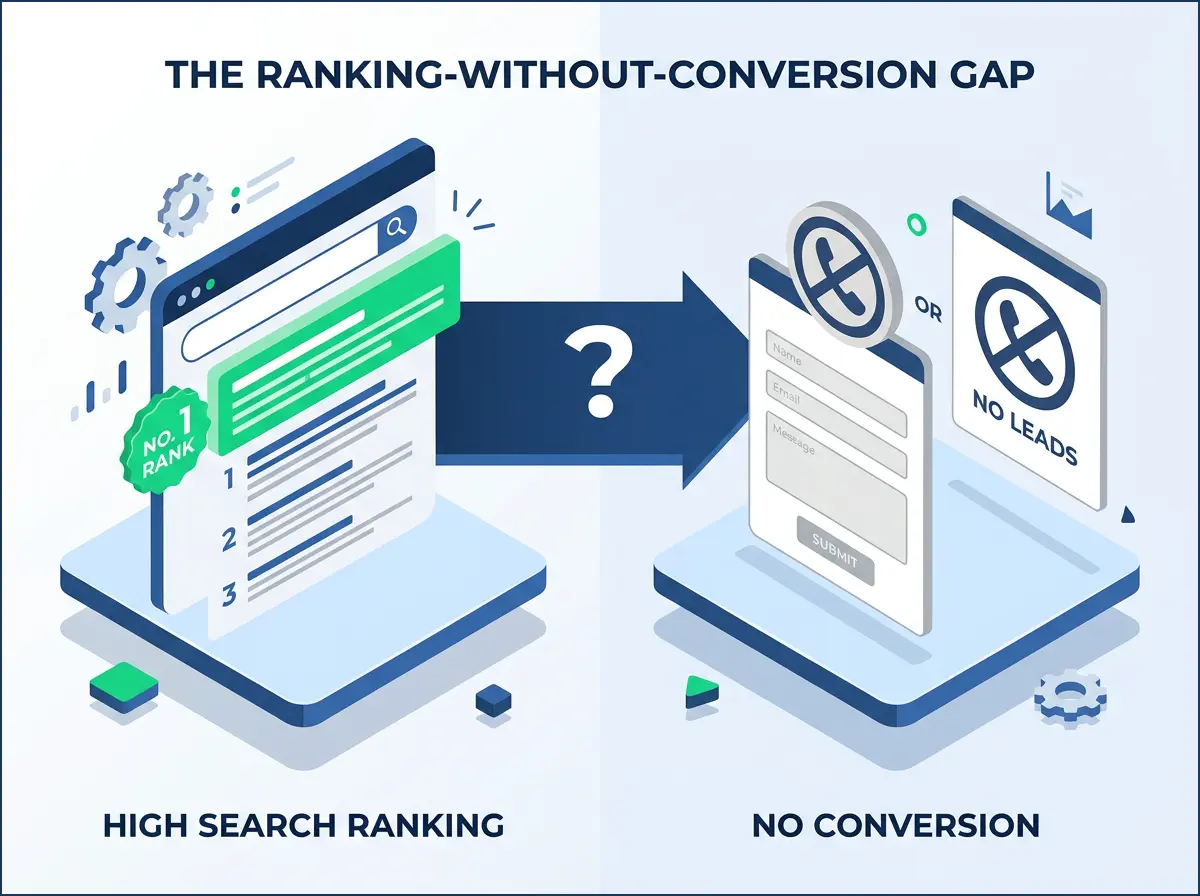
Search Experience Optimization is the layer that’s easy to forget because it happens after someone finds you. All the visibility in the world doesn’t matter if the page itself loses them.
Fast, Mobile-Friendly Pages
A site that loads quickly and works cleanly on a phone, since that’s where most of your traffic is arriving from.
Content Matched to Search Intent
Making sure the page someone lands on actually delivers what they were searching for, not a near miss.
Clear, Persuasive CTAs
Obvious next steps, whether that’s calling, booking, or filling out a form, instead of making visitors hunt for one.
Ongoing CRO Testing
Testing layout, copy, and calls to action over time instead of publishing a page once and leaving it alone.
A Frictionless Post-Click Journey
Removing anything that slows a visitor down between arriving on your site and taking action.
What we handle: usability audits and identifying what’s missing from your calls to action, including outdated patterns like hero sliders that hurt more than they help. What you can do yourself: pull up your own site on your phone right now and time how long it takes to find your phone number or booking link. If it takes more than a few seconds, so will your visitors.
Bringing It All Together
Most businesses are still operating entirely in the first layer, traditional SEO, while their competitors are starting to show up in AI-generated answers. You don’t need to master all five disciplines yourself. You need a strategy that treats them as one connected system instead of five separate projects.
Not sure where your site stands across SEO, AEO, GEO, AIO, and SXO? Get a free GO-SEO audit and see exactly where the gaps are, or browse our SEO and GEO plans to see how we handle it end to end.
Frequently Asked Questions
What is the difference between SEO and AEO?
SEO focuses on ranking a page in search results. AEO focuses on getting the content on that page selected as a direct answer, in a featured snippet, a voice response, or an AI-generated summary. SEO gets you found. AEO gets you quoted.
What is GEO in SEO?
GEO, or Generative Engine Optimization, is the practice of structuring and positioning your content so AI platforms like ChatGPT, Perplexity, and Gemini can find it, trust it, and cite it in their generated answers.
What is AIO in SEO?
AIO, or AI Optimization, is the ongoing work of building a consistent, verifiable presence across the web so AI systems recognize and trust your business over time, not just for a single query.
Do I need to do SEO, AEO, GEO, AIO, and SXO, or is SEO still enough?
SEO is still the foundation, and it remains necessary. But it’s no longer sufficient on its own. A growing share of searches are now answered directly by AI tools without a click, which means businesses that only invest in traditional SEO are becoming invisible in that space.
How long does GEO take to show results?
There’s no fixed timeline. AI citation behavior shifts month to month and varies by platform, query, and how established your existing web presence already is, so GEO is best measured as an ongoing trend rather than a single milestone.
Is schema markup enough for AEO and GEO?
No. Schema markup helps search engines and AI systems understand your content, but it doesn’t guarantee a featured snippet or an AI citation on its own. Content quality, factual accuracy, and real authority signals still do most of the work.