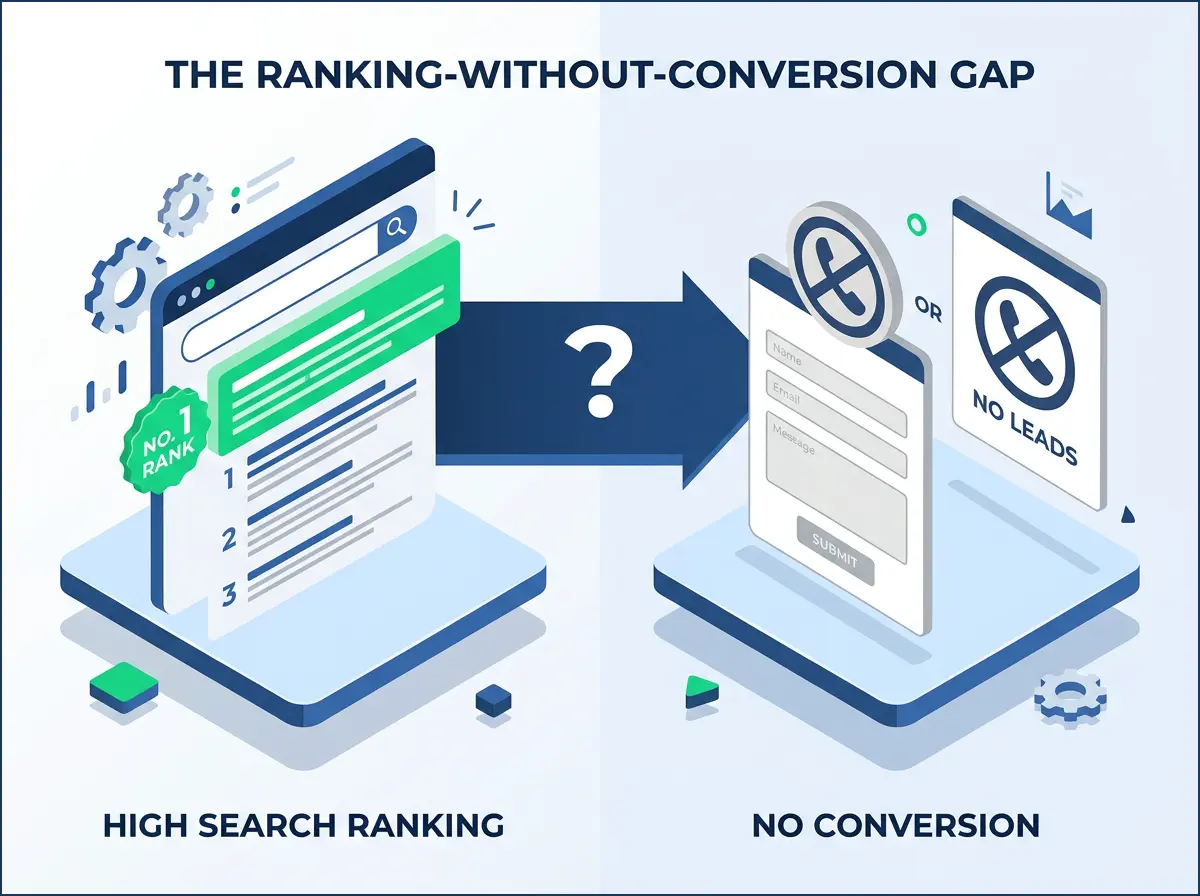
You can rank #1 for your target keyword and still watch a prospect click away without calling you. It happens more than most business owners want to admit, and it’s rarely the ranking’s fault.
People Don’t Care How You Got Found. They Care What Happens Next.
Once someone lands on your site, the ranking that got them there stops mattering. They don’t care what your product is. They don’t care about your company history, your credentials, or your process. What they’re actually asking, whether they say it out loud or not, is one question:
“What does this do for me?”
That’s it. That’s the whole filter every visitor runs your page through before they decide to call, fill out a form, or leave.
What Buyers Are Actually Shopping For
Nobody wakes up wanting a service. They want what the service produces. In practice, that comes down to a short list:
- A change in their current situation
- A problem that stops being a problem
- A result they can point to
- Or, best case, a real shift in how their business or life operates
Everything you write on your homepage, your service pages, and your proposals should be answering to one of those four things. If it isn’t, it’s noise, even if it’s accurate.
The Rule That Explains Most Buying Decisions
Here’s a useful way to think about it: a small slice of someone’s decision to buy is based on what’s happened for them in the past. The much larger share is based on what they believe is about to happen if they buy from you. Buyers aren’t evaluating your track record so much as they’re betting on their own future.
The real question in their head isn’t “is this company legitimate.” It’s “what changes for me after I say yes.”
We’ve written before about why ranking success and business success aren’t automatically the same thing, and this is the reason why. Once you see it that way, it reframes what your website, your proposals, and even your ranking are actually for. They’re not there to prove you exist. They’re there to make the buyer’s future feel real and worth paying for.
Where This Gets Interesting for SEO and GEO
This is where the ranking conversation and the sales conversation stop being separate problems.
A lot of small business content is written to satisfy a keyword, not a buyer. It leads with services offered, years in business, and a list of features, then hopes a phone number at the bottom does the closing. That approach can still rank. It just won’t convert nearly as well as it should, because it never answers the one question the visitor actually came in with. We cover this pattern in more detail in how to write homepage copy that actually works.
It matters even more now with AI search and generative engine optimization. When ChatGPT, Perplexity, or Google’s AI Overviews summarize a business for someone researching a purchase, they tend to compress a page down to its outcome, not its feature list. Content built around results and transformation gives these engines something concrete to extract and cite. Content built around company history and service descriptions often doesn’t survive the summary at all.
In other words, writing for the buyer’s future and writing for how AI engines cite businesses point in the same direction. That’s not a coincidence. Both are looking for the same signal: what actually changes for the person who buys.
Quick gut check: Pull up your own homepage or a recent proposal. Count how many sentences describe what you do versus how many describe what changes for the client. If the ratio is upside down, that’s the fix, not the ranking.
What to Stop Doing, and What to Do Instead
- Stop leading with features and specifications.
- Stop opening with company history and background.
- Stop listing services as if the list itself is the pitch.
- Start describing the specific future the client is buying into, in plain terms they’d use themselves.
This isn’t a copywriting trick. It’s a discipline. Every page, every proposal, and every piece of content you publish should pass the same test: does this describe the buyer’s future, or just your present? We’ve seen this shift move the needle for clients across very different industries, from photographers to accountants, and the pattern holds regardless of what’s being sold. You can look at some of how that’s played out for clients here.
Ranking gets people to the door. What you say once they’re inside decides whether they walk through it.
Frequently Asked Questions
Why can a business rank #1 and still get low conversions?
Ranking gets a business found. It doesn’t automatically communicate what changes for the customer after they buy. If the page content leads with features, credentials, or company background instead of the buyer’s outcome, visitors leave without converting, regardless of position on the search results page.
What should a homepage or service page lead with instead of features?
It should lead with the specific result or transformation the customer is buying, stated in plain terms. Features and process details still matter, but they belong further down the page, after the outcome has been established.
Does writing for buyer outcomes also help with AI search visibility?
Yes. AI-powered search tools like ChatGPT, Perplexity, and Google AI Overviews tend to summarize pages by their outcome rather than their feature list when citing a business. Content structured around results is more likely to survive summarization than content built around company history or service descriptions.