You have 87 reviews. Your competitor has 34. Yet they’re sitting in position one on Google Maps and you’re third, or worse, off the map entirely. It’s maddening. It also has a straightforward explanation.
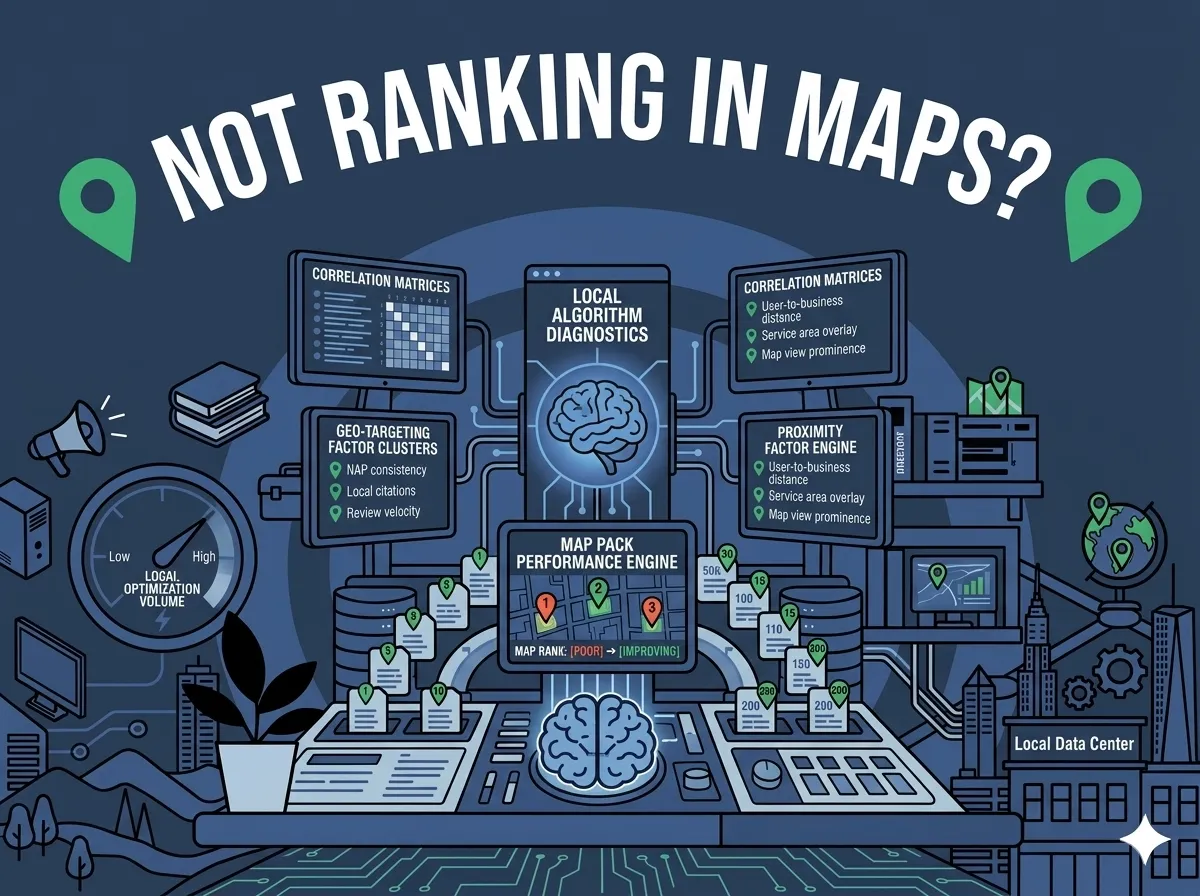
Google’s local ranking algorithm weighs three broad signals: relevance, distance, and prominence. Review count feeds into prominence, but it’s one input among many, and it’s not even the most important one. A business with fewer reviews but stronger signals across the board will beat a business coasting on a large-but-stale review count every time.
Here’s what’s actually driving the gap, and what you can do about it.
Review Count Is Not the Ranking Signal You Think It Is
Reviews matter, but recency matters more than volume. Google interprets a steady stream of new reviews as a signal that a business is active, relevant, and trusted right now. A competitor who collected 30 reviews over the last six months looks more credible to Google’s algorithm than a business with 80 reviews, the last of which came in fourteen months ago.
The practical fix: make review requests part of your post-job or post-visit routine. Not a one-time campaign, but an ongoing process. One or two new reviews per month, consistently, is worth more than a blitz that goes quiet. For a deeper look at how Google handles reviews including the shift to pseudonymous profiles, see our breakdown of Google’s November 2025 review update.
Six Factors That Are Likely Beating You Right Now
1. Category Accuracy
Your primary Google Business Profile category is one of the highest-impact settings in your entire profile. If it doesn’t precisely match what you do, you’re invisible for searches where you should be front and center. “General Contractor” and “Kitchen Remodeler” are not interchangeable, Google treats them as different businesses serving different queries.
Check your primary category against the categories your top-ranked competitors are using. If they’re more specific and more accurate, that’s likely contributing to the gap.
2. NAP Consistency Across the Web
NAP stands for Name, Address, Phone number. Google cross-references your GBP data against dozens of third-party directories: Yelp, YellowPages, Bing Places, Apple Maps, industry-specific directories, and more. Inconsistencies, even minor ones like “St.” vs. “Street” or a phone number formatted differently, erode trust signals.
This one is easy to overlook because the errors are often inherited from old listings you set up years ago and forgot about. We’ve written about how NAP inconsistency affects rankings in detail — it’s more common (and more damaging) than most business owners realize.
3. GBP Post Frequency
Most businesses create their Google Business Profile and never touch it again. That inactivity is a ranking signal in itself. Google favors profiles that show signs of life: new photos, weekly posts, updated offers, responses to reviews.
Posting to GBP weekly isn’t a massive time investment, a photo with two sentences is enough, but almost no small businesses do it consistently. That gap is an easy win if you’re willing to put in fifteen minutes a week. See also: how GBP Q&As can further boost your local SEO.
4. Keyword Relevance in Your Profile
Your business description, posts, and even your responses to reviews are indexed by Google. That means the language you use in your profile directly affects which search queries you show up for. If you’re a plumber in Burbank and your description says “We provide quality plumbing services,” you’re leaving real estate on the table. Be specific about what you do and where.
Use the exact terms your customers type into search, not industry jargon, not vague category language. Tools like Google’s Autocomplete and People Also Search For can surface the phrases worth including.
5. Profile Completeness
Google rewards profiles that are fully filled out. Hours, holiday hours, attributes (wheelchair accessible, women-led, online appointments, etc.), services and products. Every field you leave blank is a missed signal. Run through your profile field by field. If there’s a section you’ve skipped, fill it in.
For a full walkthrough of setting up and optimizing a GBP from scratch, our 2025 step-by-step GBP tutorial covers every section. And for the bigger picture on why GBP optimization translates to actual conversions, not just rankings, read why GBP is essential for local conversions.
6. Distance
This one you can’t optimize. If a searcher is physically closer to your competitor, Google will generally rank them higher for that query. It’s not a bug, proximity is a core part of what makes local search useful.
What you can do: focus on the signals above so that when distance isn’t a decisive factor, you win. And make sure your service area in GBP accurately reflects where you actually work, especially if you’re a service-area business without a storefront.
Start With a GBP Audit
Before you do anything else, audit your current profile for completeness and accuracy. This doesn’t need to be complicated:
- Is every field filled in?
- Is your primary category the most specific and accurate match for your business?
- Are your hours correct, including holidays?
- When was your last post? Your last new photo?
- Do your name, address, and phone number match exactly across Yelp, Bing Places, Apple Maps, and your top directory listings?
- When was your most recent review? And have you responded to it?
Most businesses find at least two or three fixable issues in this list. Address those first before pursuing more aggressive tactics.
Want a professional set of eyes on your Google Business Profile? GO-SEO’s local SEO work includes a full GBP audit and ongoing optimization as part of every retainer. Learn more about local SEO or get in touch to talk through your situation.
Does Your Business Type Change the Approach?
Yes. The fundamentals above apply to everyone, but some business types have additional levers worth pulling.
Restaurants and Food Service
For restaurants, photos carry outsized weight, both as a ranking signal and as a conversion factor. A Google Business Profile with fresh, high-quality food photos posted weekly will outperform a bare profile regardless of review count. Update your menu section in GBP any time it changes; Google can pull directly from your GBP menu for certain queries. Enable online ordering or reservations links if you use those services, and respond to every review. Google watches review response rate for restaurants specifically. Categories matter too: “Italian Restaurant” will outperform “Restaurant” for relevant searches. Use every applicable secondary category.
Service-Area Businesses (Plumbers, Electricians, HVAC, Landscapers, Cleaners, etc.)
If you work at customer locations rather than a storefront, your service-area settings in GBP are critical. Be explicit about every city and neighborhood you serve. Don’t hide your address if you have one. Businesses with a visible address get a local-pack proximity advantage for searches near that location. Project photos (before/after, job-site shots) are your equivalent of restaurant food photos, post them consistently. For tradespeople especially, Google’s Local Services Ads (the “Google Guaranteed” badge listings above the Maps pack) are worth pursuing alongside organic GBP optimization; they require a background check and license verification, which most competitors skip.
Also worth reading: How to get your business into the Google Maps Pack — a full breakdown of what it takes to earn a spot in the three-pack.
The Honest Bottom Line
Outranking a competitor on Google Maps is rarely about one thing. It’s usually a combination of signals and the businesses in position one have typically gotten more of them right, not just one big one. Review count is visible and feels measurable, which is why people fixate on it. But category accuracy, NAP consistency, post frequency, and profile completeness are often easier to fix and faster to move the needle.
If you want to understand where your local SEO actually stands including how well your GBP is performing relative to competitors, our technical audit includes a local search component. Or if you’re ready to talk specifics, reach out directly. We answer our own phone.
Frequently Asked Questions
Does having more Google reviews guarantee a higher Maps ranking?
No. Review count is one signal among many in Google’s local ranking algorithm. Review recency, category accuracy, NAP consistency, posting frequency, and profile completeness all carry significant weight. A competitor with fewer reviews but stronger signals in these other areas will often outrank a business with a larger but older review base.
How often should I post to my Google Business Profile?
Weekly is the target most SEOs recommend, and it’s what Google’s own guidance supports. Posts don’t need to be elaborate. A photo with a short caption about a recent job, a seasonal offer, or a quick tip for customers is enough. Consistency matters more than production value.
What is NAP consistency and why does it affect Google Maps rankings?
NAP stands for Name, Address, and Phone number. Google cross-references your Google Business Profile data against third-party directories and citations across the web. If your business name, address, or phone number appears differently in those sources (even minor formatting differences) it creates conflicting data that can suppress your local rankings. Auditing and correcting these inconsistencies is one of the highest-ROI local SEO tasks for most businesses.
Can distance from the searcher be overcome with better optimization?
Partially. Distance is a built-in factor in Google’s local algorithm and can’t be eliminated. But strong signals in other areas such as category relevance, review recency, post frequency, and profile completeness can help you rank well even when you’re not the closest option, particularly for queries where relevance outweighs proximity.
Which Google Business Profile fields matter most for local rankings?
Primary category is consistently cited as one of the highest-impact fields. After that: business description (keyword relevance), services and products sections, photos (frequency and quality), and review responses. Hours accuracy (including special holiday hours) also plays a role in Google’s confidence in your listing.
Do I need to respond to every Google review?
Responding to every review is best practice, and Google has confirmed that review responses are a signal it factors into local prominence scores. Beyond rankings, response rate is one of the first things potential customers look at when evaluating whether to trust a business. Responding to negative reviews professionally is especially valuable.